How To Overcome Intrusive Thoughts & OCD
If you ask me what has been the most challenging thing I’ve experienced in my life, I wouldn’t say agoraphobia or even my last breakup, and those two things were damn challenging.
I would tell you that the most difficult thing I’ve ever overcome and continue to overcome periodically is the insufferable episodes of OCD.
No. Not the “I need everything to be perfect and tidy” type of OCD.
I’m talking about the intrusive thoughts that eat you from the inside out. The maggots that overcome your entire brain and feed on it. You don’t know your mental strength until you get through one of these bad boys.
I’ve had episodes that lasted over 3 weeks. 3 WEEKS of pure unadulterated HELL.
These aren’t your typical intrusive thoughts, the ones where you think: “I wonder what would happen if I were to just…swerve my car into oncoming traffic”. No, not those.
The ones I’m referring to are the intrusive thoughts that have you questioning your entire reality, not knowing what the heck is real or how you TRULY feel. It feels like Satan is living inside of you, convincing you that you feel a certain way when you know for a fact that you don’t. Disguising itself as “intuition” for the added persuasive effect. Then you’re confused, and scared, and suddenly it’s all you think about.
The more you think about it, the bigger it gets and the more compulsive you become to prove yourself wrong. It alleviates it all for a split second. The sweet relief. “I’m not insane, it’s just a silly little episode.” “I’m fine! I don’t actually feel this way, thank goodness. Now I can go about my day.”
Then BAM!
It comes back, even stronger than before.
It feels inescapable, the thoughts haunting you and leaving a sense of dread fermenting in your stomach.
My episodes are hormonally triggered, so when I experience fluctuations (especially on birth control, I’ve noticed), they get particularly bad. They go away whenever they’re ready. I would randomly wake up feeling normal again. All thoughts and feelings are completely gone. The fog lifted and cleared.
Every time I think about what else I could possibly worry about, something new and batshit crazy pops up. I never fail to surprise myself. Sometimes, the thoughts are so funny to me, and yet, they are so convincing and terrifying.
I’ll get personal with you here…and don’t judge.
I’ve had OCD episodes revolving mostly around relationships and identity. The guilt would simply eat me alive.
“Oh no, am I not attracted to my partner anymore?”
“Do I even love them?”
“What if I cheat on them?”
“I’m a horrible person for even thinking that!”
“I should end it before I hurt them!”
To clarify, I love my partner to death, and I would literally die for this man.
Anyway, those are just some of the tamer ones. LOL.
There is nothing I can do except laugh at how preposterous these thoughts are.
I’m fully aware that it’s an OCD episode, because I don’t truly feel like this in the slightest, and yet my brain is so darn convincing and the biggest drama queen.
I’ve also had the common:
“Am I a sociopath?”
“Do I have a dark passenger???” (Dexter 2.0)
“Am I inherently evil?”
“Do I even care, or am I inherently selfish?”
Yeah…it’s A LOT.
The fact is, you are battling with the awareness of your irrationality and the compelling nature of these thoughts. You are battling with an identity your brain is trying to force feed you, and the cognitive dissonance sends you into a spiral. It feels like you’re pushing a wall that’s caving in, and it’s taking all of your strength not to collapse underneath it.
I haven’t mastered the fight just yet; in fact, I’m in the middle of an episode as I’m writing this.
But, I do have some advice for those of you going through this exhausting experience.
Write it all down.
Get it out in the open. Writing it down takes away some of its power, and that’s what you want. You want to deprive it of power.
Get your hormones in check.
Hormonal fluctuations play a massive role in OCD, especially in women. My episodes are strictly hormonal; I don’t have them outside of that (luckily).
Don’t tell anyone about your intrusive thoughts.
If you’re having intrusive thoughts about your relationships (romantic or otherwise), no matter how convincing and urgent they may appear, do NOT tell that person. You telling them will only relieve your own guilt, while completely destroying them. It’s not worth it.
Rise above it.
Acknowledge that you’re having an episode, and that nothing you’re experiencing is rational or legitimate. I want you to view it as a prank your brain is playing on you. Seriously, the thoughts you have are ridiculous, especially when you come out of the episode it becomes very apparent.
Know that the guilt you’re feeling is actually a sign that you’re a good person.
A bad person would feel no guilt whatsoever. You’re not evil.
The intrusive thoughts you’re having are always the complete opposite of how you truly feel.
Always. Think of your brain as being in a reverse circuit, thinking and feeling the opposite of how you would normally. Your brain is a washing machine, and it’s just in a reverse cycle, it’ll stop eventually. When? Who knows. But it will stop, and that’s a fact.
Wait it out.
Do your best to distract yourself as much as possible, because the more you pay attention to the thoughts, the louder they become.
Use these thoughts as entertainment.
Acknowledge how absurd it all is, and find humour in it. The less serious you are, the easier it is.
The more resistance, the more convincing.
If you keep resisting a thought, you subconsciously convince yourself that the thought is true. That further amplifies the anxiety, and the loop continues. Just let it exist, let it run its course no matter how wild it is. Easier said than done, I know.
Find people in the same boat as you.
I’d browse through Reddit and find people who shared my experience, and there’s something very comforting about not being alone in your thoughts.
Don’t mistake intrusive thoughts as intuition.
Your intuition doesn’t exist in these moments; it can’t coexist.
Question those thoughts and provide evidence against them.
Cognitive Behavioural Therapy (CBT) can be very helpful with these kinds of episodes. You want to be brought back to reality as much as possible.
Get out of your head and into the world.
Go for a walk, touch some damn grass. Go train at the gym. Do anything active.
Think about the underlying issue.
Why is it that you have OCD episodes? Is there a common theme to them? Oftentimes, a sense of entrapment within the self or the inability to escape the thoughts and being forced to accept a new mental reality can feel distressing. What is it you’re really afraid of? Are you afraid of the thoughts being true? If so, why is that? What’s the worst that could happen? Keep asking yourself questions to hopefully discover the underlying fear.
The bright side is that with each episode, you become stronger. Each episode that arises gets easier with time. When you’re in it, it’s like being inside a tornado; you can’t see what lies outside of it, and it’s almost impossible to escape. Knowing that there will be an end to it is a comforting thought.
Don’t ever feel ashamed about the intrusive thoughts you have. Intrusive thoughts are indeed intrusive and incredibly distressing. They have no basis in reality, nor do they provide any indication of who you are as a person. You’re not evil, you’re human. There’s nothing wrong with you; your brain is just a funny little washing machine.
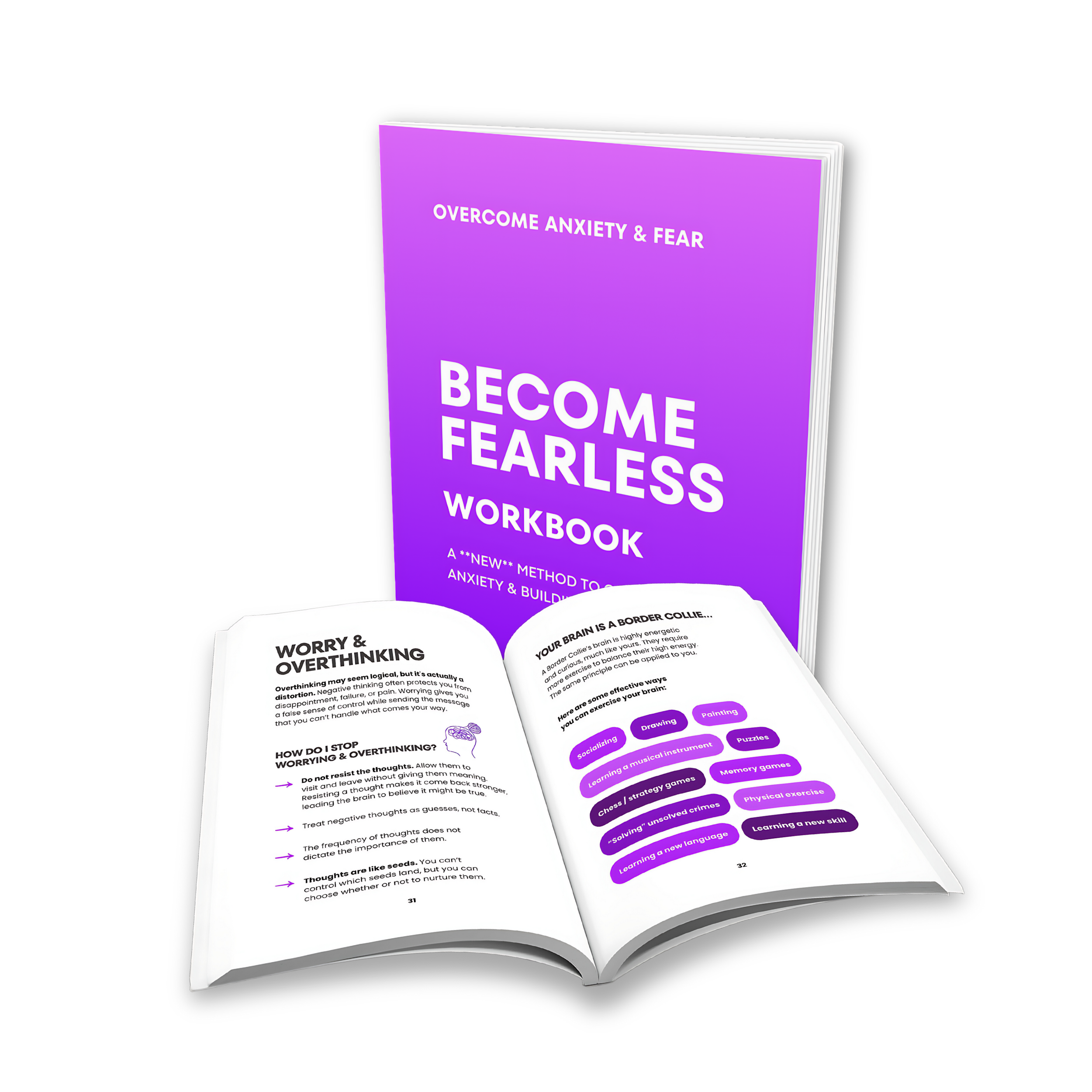
** DIGITAL WORKBOOK **
Are you sick and tired of anxiety ruining your life?
Become Fearless is your most lethal weapon against anxiety.
Using The CRAVED Method, a NEW anxiety-busting technique that flips fear on its head, this practical approach helps you rewire your brain and control panic like never before.
This isn’t your run-of-the-mill workbook. This is your anxiety-fighting sidekick that’ll make fear feel like that awkward acquaintance you bump into every few years: brief and completely manageable.
Why Choose 'Become Fearless'?
Evidence-based solutions
The CRAVED Method—a brand new approach you won’t find anywhere else
Overcome anxiety without relying on medication
Hack your brain using neuroscience
Strengthen your mental and physical resilience
Step-by-step guidance to become truly FEARLESS
Simple, easy-to-understand concepts with real-world application
What's inside?
8x Fillable PDFs
Instructions
“As someone who is diagnosed with anxiety this book has really helped me with dealing with my panic attacks.” — Mia (16)